Most advice about cracked windshields is written for nowhere in particular. This is written for drivers registered in Hamilton County, because the rules that decide whether you get pulled over, whether an inspector ever sees the damage, and whether your insurer pays for the glass are all set in Nashville, not by the shop doing the work.
Here is what actually applies to you in Tennessee, and where the common assumptions get it wrong.
Is a Cracked Windshield Illegal in Tennessee?
There is no statute in Tennessee that says a crack becomes illegal at six inches, or that a chip larger than a quarter earns you a citation. States that publish a specific measurement are the exception, and Tennessee is not one of them. What the Tennessee Code regulates instead is obstruction of the driver's view, and it leaves the judgment call to the officer at the window.
In practice that means location matters far more than length. A star break low on the passenger side is unlikely to interest anyone. A crack running horizontally through the band of glass the driver actually looks through, the area your wipers sweep directly in front of the steering wheel, is the one that draws a stop, and it is also the one that will fail you on a repair-versus-replace assessment regardless of what the law says.
Two related requirements catch people off guard. If your vehicle has a windshield, it must have working wipers. And any aftermarket tint, sunstrip, or sticker placement on the glass is regulated separately from the damage itself. A cracked windshield plus a non-compliant tint strip is two conversations, not one.
Tennessee Has No Safety Inspection. That Changes the Math
Some states give drivers a yearly checkpoint where somebody besides them looks over the vehicle. Tennessee is not one of them. There is no annual safety inspection for non-commercial vehicles here, and the county-level emissions testing program that once covered Hamilton County was discontinued in 2022. Nothing in the registration process puts a second set of eyes on your glass. Hamilton County are not among them.
So for an Chattanooga driver, there is now no routine, scheduled moment when a professional examines your glass and tells you it has gotten worse. The administrative backstop is gone. What is left is roadside enforcement, and physics.
Commercial vehicles are the exception and still face inspection, which matters in this part of the state. If you run a truck up I-75 toward Cleveland or haul through the Ridge Cut on I-24, federal out-of-service criteria treat cracks and discoloration in the driver's viewing area far more strictly than anything applied to a personal vehicle. A crack that is a nuisance in a pickup can put a commercial unit out of service.
What the Glass Is Actually Doing Up There
The reason to fix damage has never really been the citation. A modern windshield is bonded to the body with structural urethane and is a load-bearing part of the passenger cell. In a rollover it contributes a substantial share of the roof's resistance to crushing. In a frontal collision, the passenger-side airbag does not deploy into open space, it deploys upward against the inside of the windshield, which redirects it toward the passenger. If the urethane bond or the glass edge is compromised, the airbag can push the windshield out instead of bouncing off it.
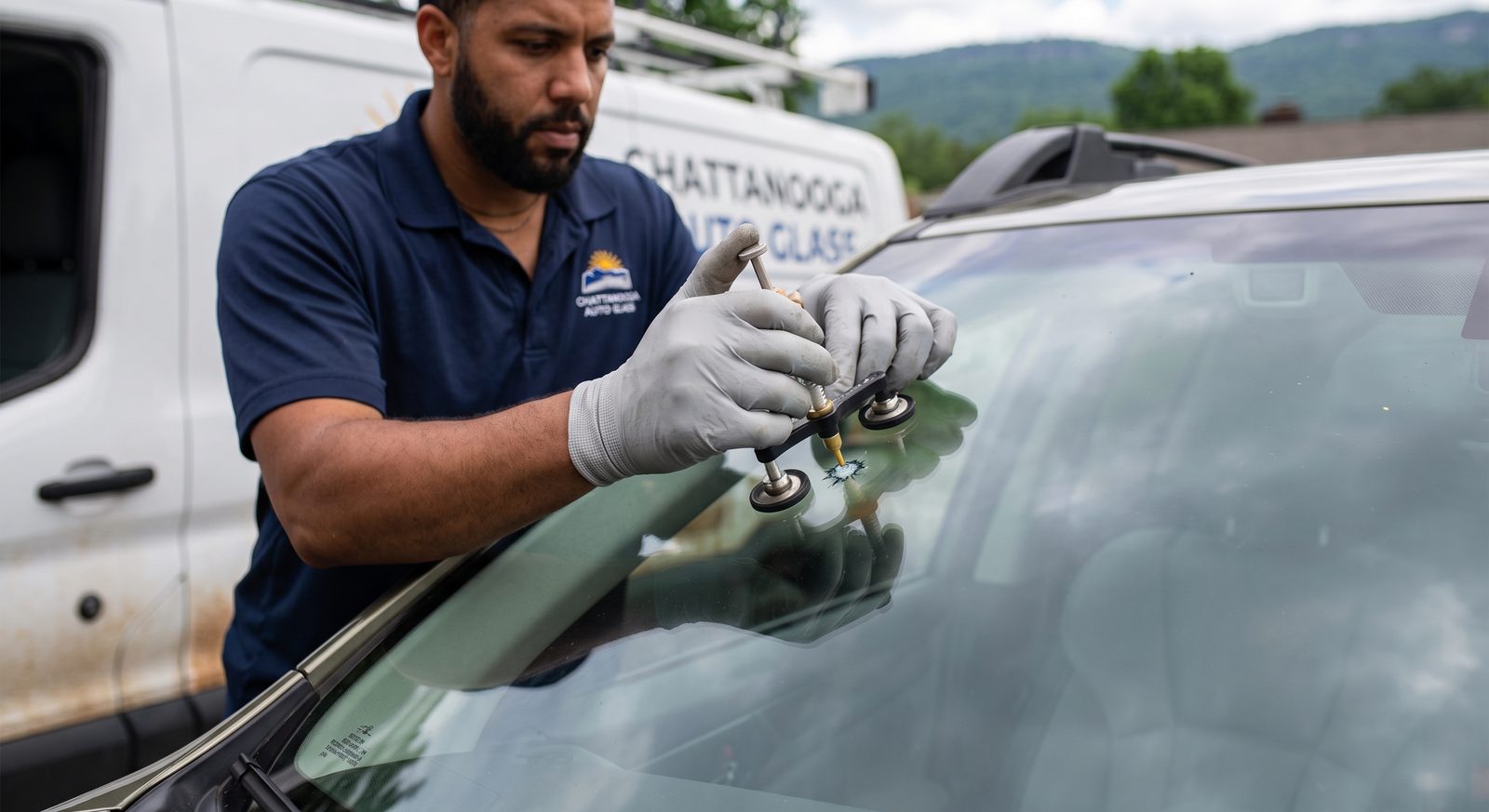
That is why technicians treat a crack that reaches within about two inches of the edge as an automatic replacement, no matter how short it is. The middle of the glass is a visibility problem. The edge is a structural one.
Does Tennessee Make Insurers Cover Glass for Free?
No, and this is the single most common misconception we hear on the phone. A handful of states, Florida, Kentucky, and South Carolina among them, have statutes requiring insurers to cover windshield replacement with no deductible. Tennessee has no such law. Nobody is legally obligated to hand you free glass.
What you have instead is your policy. Glass damage falls under comprehensive coverage, not liability and not collision. If you carry liability only, which is legal in Tennessee, glass is entirely out of pocket. If you carry comprehensive, your deductible applies unless you bought something extra.
That "something extra" is worth asking about by name. Many Tennessee insurers sell a glass endorsement, sometimes called a waiver or a zero-deductible glass rider, for a modest premium. It is not automatic and it is not on every policy. A related and very common arrangement: insurers frequently waive the deductible for a chip repair while still applying it to a full replacement, simply because filling a chip is dramatically cheaper than replacing the windshield. If that describes your policy, waiting until the chip becomes a crack converts a free repair into a deductible-sized bill.
Your Insurer Can Recommend a Shop. It Cannot Require One
Tennessee law protects your right to choose who repairs your vehicle. An insurer is allowed to suggest a shop in its network and is allowed to tell you what it will pay. It is not allowed to condition your claim on using a particular facility. If a claims call leaves you with the impression that you have to go somewhere specific, you can decline and name your own shop, and the claim proceeds.
This matters more than it sounds. Network pricing sometimes pushes toward the cheapest available glass, and on a vehicle with a camera mounted behind the windshield, the specification of the glass is not a cosmetic detail.
Hail Claims Work Differently Than You Expect
Chattanooga sits in one of the more active hail corridors in the country, and comprehensive coverage is what responds to hail. Two practical notes. First, a glass-only claim is generally not treated as an at-fault loss, since nobody argues you caused the hailstorm; ask your insurer how they classify it before assuming a claim will cost you at renewal. Second, after a significant Tennessee Valley storm the body shops back up for weeks while glass work often moves quickly, so it can make sense to handle the windshield as its own claim rather than waiting on a single combined estimate for roof and hood dents.
What to Have Ready When You File
- Photographs of the damage taken before any work, including one wide shot showing where on the glass it sits.
- The date and approximate location the damage occurred. For hail, the National Weather Service office in Chattanooga publishes storm reports that corroborate a date.
- Your VIN, which determines the correct glass part and whether a camera is involved.
- A list of driver-assistance features your vehicle has: lane keeping, adaptive cruise, automatic braking, rain sensing.
- The final invoice, including any calibration line item, which you will want if a system misbehaves later.
The Practical Summary
Tennessee will not schedule a reminder for you anymore, will not hand you free glass, and will not tell you a crack is too long until an officer decides it is. The decision is entirely yours, and it is cheapest at the chip stage. If you are not sure which category your damage falls into, call (423) 396-1105 and describe where it sits on the glass. That one detail usually settles it.
A note on this article: this is general information for Tennessee drivers, not legal or insurance advice. Statutes, inspection requirements, and policy terms change. Confirm coverage details with your own insurer and current requirements with the Hamilton County Clerk or the Tennessee Department of Revenue before making a decision that depends on them.
Need Service in the Chattanooga Metro?
We provide mobile windshield repair and replacement throughout Chattanooga, East Ridge, Red Bank, Soddy-Daisy, Ooltewah, Cleveland, Fort Oglethorpe, and Ringgold. Call now or fill out the form to the right for a free estimate.
Call (423) 396-1105